Tip Responder Resources
The Washington State Attorney General’s Office developed the resources on this page. These resources provide tip responder agencies with the information they need to access the HearMeWA Tip Manager and training for using the Tip Manager to respond to tips.
Terms of Service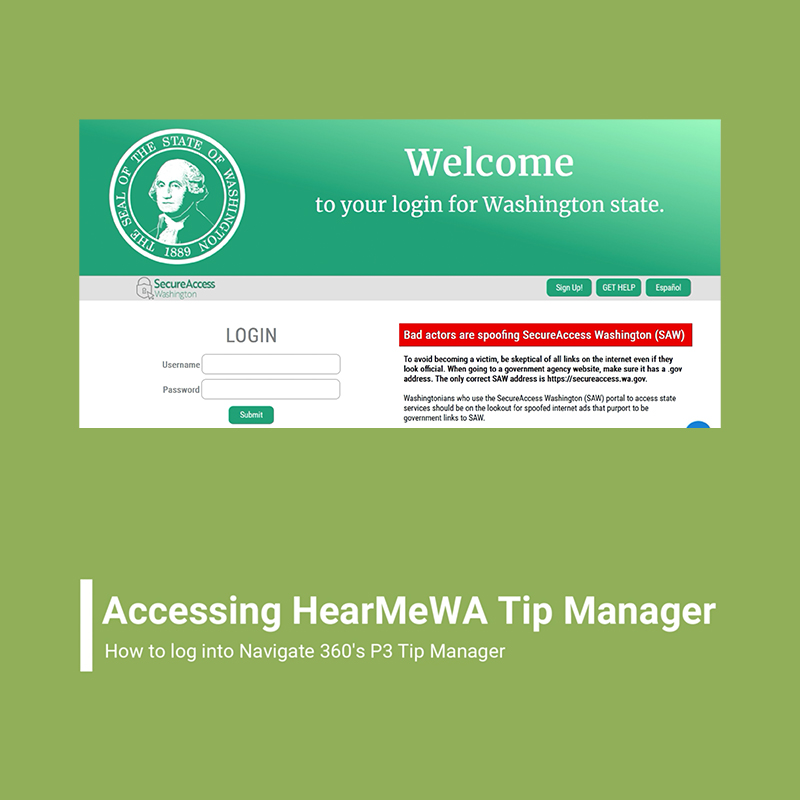
Accessing HearMeWA Tip Manager (Video)
Accessing HearMeWA Tip Manager (Document)
Best Practices Toolkit
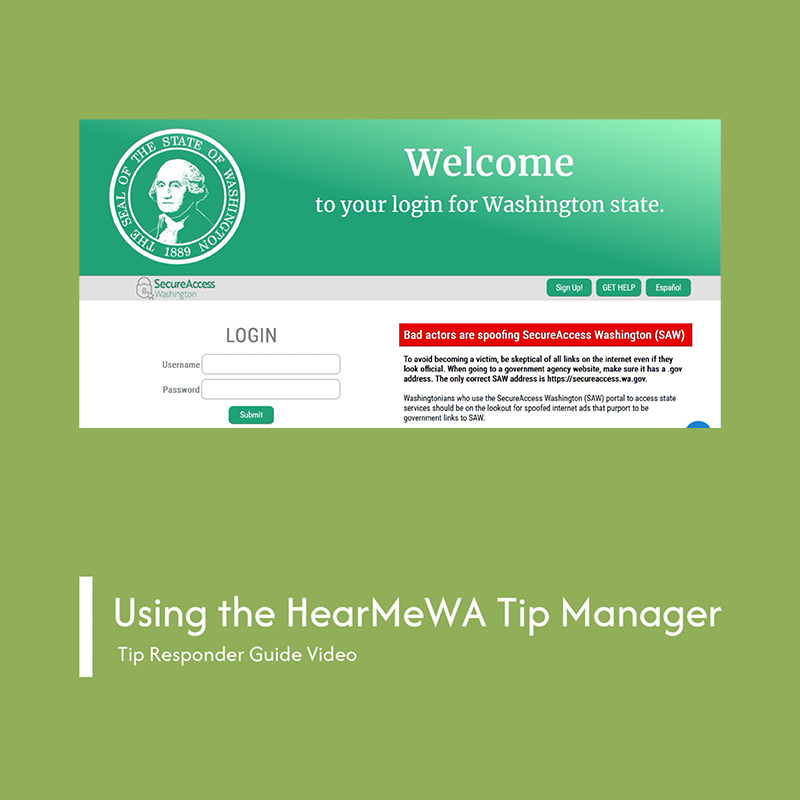
Tip Response and Disposition (Video)
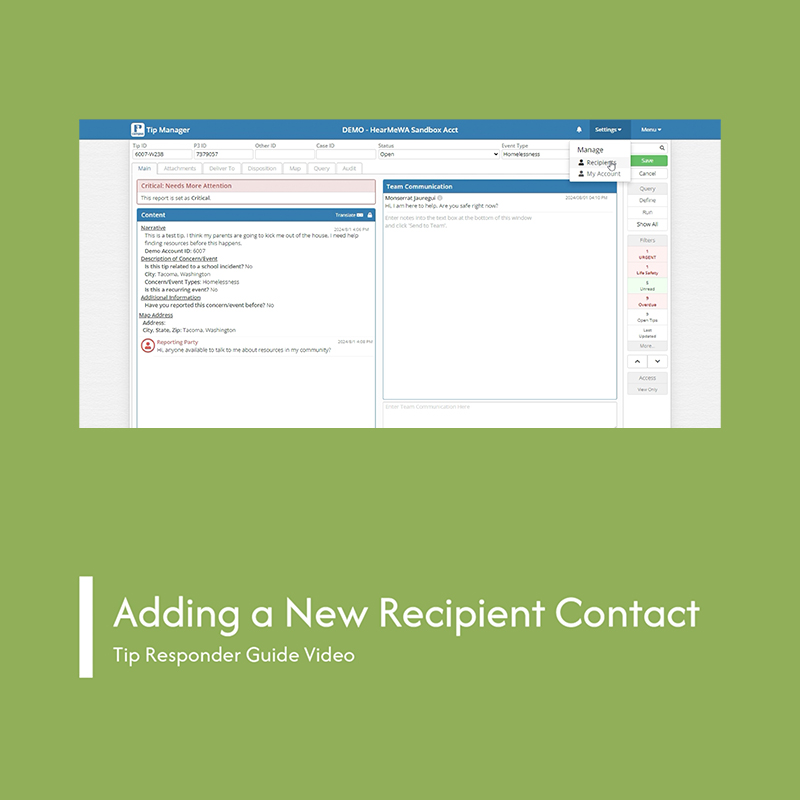
Adding a New Recipient Contact (Video)
This is a customizable sample letter intended for school administrators (principals, superintendents, district leaders) to send to parents and caretakers announcing their school or district’s partnership with HearMeWA.
Download (.docx)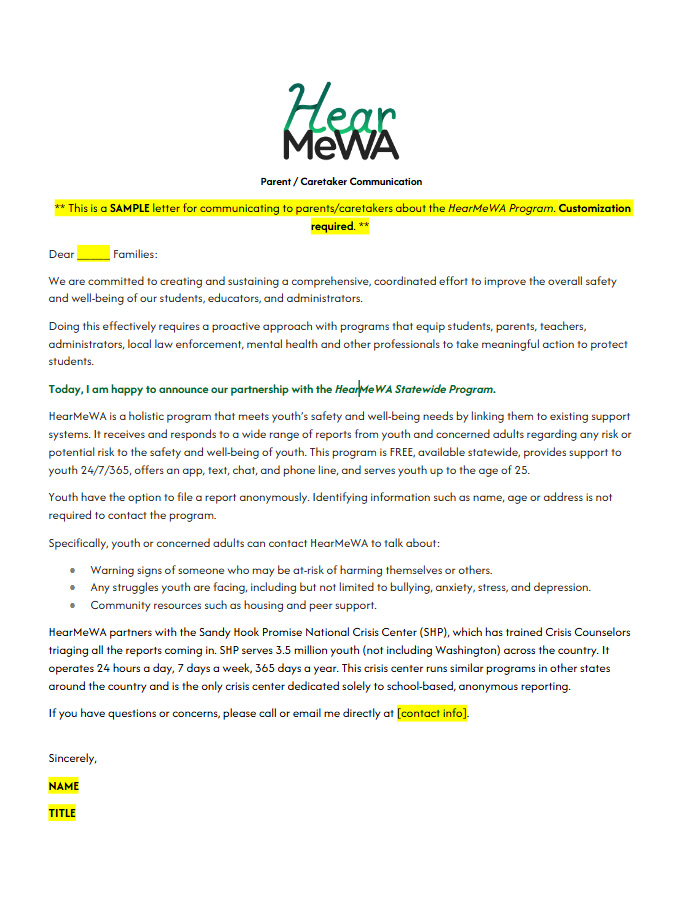
Who qualifies as a tip responder?
Tip responders are the agencies/organizations that receive and respond to tips from HearMeWA. These include educational services (K-12 and higher education), behavioral health services (988 and Regional Crisis Lines), law enforcement (911 and local law enforcement agencies) and Child Protective Services (CPS).
When youth contact HearMeWA, they talk to a Sandy Hook Promise trained crisis counselor who is available 24/7/365 to help youth with any concern they may have. The crisis counselors triage the tip and send the information to the appropriate tip responder. For more information about this process, please refer to the HearMeWA Best Practices Toolkit.
What is the HearMeWA Tip Manager and how can tip responders access it? The HearMeWA Tip Manager is the platform that tip responders use to communicate with crisis counselors, see tip information, and any dialogue between the tipster and crisis counselors. Tip responders receive notifications via email, text, and/or phone call when there is a tip in the Tip Manager for their agency/organization.
Here are the steps for setting up an account with HearMeWA to access the Tip Manager:
Are tip responders required to participate? No. However, because HearMeWA is not an opt-in/opt-out program for tip responders, the crisis center will notify tip responders whenever their agency/organization is identified in the tip triage process. The crisis center will notify tip responders in different ways depending on the urgency level of the tip, and whether the tip responder agency/organization has access to the HearMeWA Tip Manager. Tip notifications include phone calls, text messages, and emails. For more information on when and how the crisis center will notify tip responders, what is expected from them, and how to access tips via the HearMeWA Tip Manager, please refer to the HearMeWA Best Practices Toolkit.
How are tips triaged? The Sandy Hook Promise Crisis Center uses the HearMeWA flowchart (page 14 on the HearMeWA Best Practices Toolkit), to identify the appropriate agency for referral. The tip referral process varies based on the amount of information the crisis counselors can gather, the tip category, and the urgency level of the tip. The Attorney General’s Office consulted with the HearMeWA Advisory Committee as it developed the tip response process, including defining tip urgency levels, tip categories, and creating a flowchart. For more information, please refer to the HearMeWA Best Practices Toolkit.
How does HearMeWA interact with 988 and the Regional Crisis Lines? The crisis center will refer youth to 988 and/or the Regional Crisis Lines when they are looking for behavioral health support. After engaging in a conversation with youth and de-escalating the situation, the crisis counselors will inform youth about 988 and the services they provide (Native and Strong Lifeline, Veterans, LGBTQIA2S+, Spanish Line).
If a youth with a behavioral health need requires in-person crisis response, crisis counselors will “warm transfer” them to their regional crisis line, meaning they will connect them and pass along the relevant information, so the caller does not have to repeat it.
How will it be determined if a report gets routed to 911? The crisis center will notify 911 any time a report is categorized as “life-safety,” meaning any imminent threat to life such as an active shooter, suicidal threats, overdose, explosives threats, someone with a firearm or other dangerous situations that put lives or safety at immediate risk.
How does HearMeWA handle prank tips? Like all anonymous reporting programs, HearMeWA is subject to prank/hoax tips. Of all tips received by Sandy Hook Promise Crisis Center, about 3% are deemed to be a prank/hoax tip. Sandy Hook Promise Crisis Center vets tips for validity and has a protocol to handle these tips.
Per RCW 9A.84.040, intentionally providing false information to the program may lead to prosecution.
How much time do tip responders have to close tips in the HearMeWA Tip Manager? HearMeWA does not have governance over tip responders, however we encourage them to close tips by completing and submitting a disposition report in the HearMeWA Tip Manager. Tip responders have seven days to close and submit a disposition report, if they miss the deadline, crisis counselors will send a reminder every day for 30 days or until they submit a disposition report. For more information about this process, please refer to the HearMeWA Best Practices Toolkit.
How can tip responders communicate with the Crisis Center if they have a question about a tip? There are two ways tip responders can communicate with the crisis center:
Some existing services can offer youth help, but sometimes youth do not know those resources exist, or they have trouble accessing them. HearMeWA removes those barriers. With an increasingly hybrid world, youth who do not have resources available where they live may be able to connect with useful resources in another community with the help of HearMeWA.
My question wasn’t answered. What should I do? You can contact the Attorney General’s Office Youth Program Team at infohearmewa@atg.wa.gov, 833-398-0179 or through the HearMeWA Contact Form.
When youth contact HearMeWA, they talk to a Sandy Hook Promise trained crisis counselor who is available 24/7/365 to help youth with any concern they may have. The crisis counselors triage the tip and send the information to the appropriate tip responder. For more information about this process, please refer to the HearMeWA Best Practices Toolkit.
What is the HearMeWA Tip Manager and how can tip responders access it? The HearMeWA Tip Manager is the platform that tip responders use to communicate with crisis counselors, see tip information, and any dialogue between the tipster and crisis counselors. Tip responders receive notifications via email, text, and/or phone call when there is a tip in the Tip Manager for their agency/organization.
Here are the steps for setting up an account with HearMeWA to access the Tip Manager:
- If you have not yet done so, contact the HearMeWA team to let them know you are the point of contact (also known as the “recipient contact administrator”) for your agency/organization. Skip this step if your agency/organization already has a recipient contact administrator.
- Create a Secure Access Washington (SAW) account. Follow the instructions in this document or watch the Access HearMeWA Tip Manager Instructions video for more information.
- After creating your SAW account, you will be prompted to log into the HearMeWA Tip Manager.
Are tip responders required to participate? No. However, because HearMeWA is not an opt-in/opt-out program for tip responders, the crisis center will notify tip responders whenever their agency/organization is identified in the tip triage process. The crisis center will notify tip responders in different ways depending on the urgency level of the tip, and whether the tip responder agency/organization has access to the HearMeWA Tip Manager. Tip notifications include phone calls, text messages, and emails. For more information on when and how the crisis center will notify tip responders, what is expected from them, and how to access tips via the HearMeWA Tip Manager, please refer to the HearMeWA Best Practices Toolkit.
How are tips triaged? The Sandy Hook Promise Crisis Center uses the HearMeWA flowchart (page 14 on the HearMeWA Best Practices Toolkit), to identify the appropriate agency for referral. The tip referral process varies based on the amount of information the crisis counselors can gather, the tip category, and the urgency level of the tip. The Attorney General’s Office consulted with the HearMeWA Advisory Committee as it developed the tip response process, including defining tip urgency levels, tip categories, and creating a flowchart. For more information, please refer to the HearMeWA Best Practices Toolkit.
How does HearMeWA interact with 988 and the Regional Crisis Lines? The crisis center will refer youth to 988 and/or the Regional Crisis Lines when they are looking for behavioral health support. After engaging in a conversation with youth and de-escalating the situation, the crisis counselors will inform youth about 988 and the services they provide (Native and Strong Lifeline, Veterans, LGBTQIA2S+, Spanish Line).
If a youth with a behavioral health need requires in-person crisis response, crisis counselors will “warm transfer” them to their regional crisis line, meaning they will connect them and pass along the relevant information, so the caller does not have to repeat it.
How will it be determined if a report gets routed to 911? The crisis center will notify 911 any time a report is categorized as “life-safety,” meaning any imminent threat to life such as an active shooter, suicidal threats, overdose, explosives threats, someone with a firearm or other dangerous situations that put lives or safety at immediate risk.
How does HearMeWA handle prank tips? Like all anonymous reporting programs, HearMeWA is subject to prank/hoax tips. Of all tips received by Sandy Hook Promise Crisis Center, about 3% are deemed to be a prank/hoax tip. Sandy Hook Promise Crisis Center vets tips for validity and has a protocol to handle these tips.
Per RCW 9A.84.040, intentionally providing false information to the program may lead to prosecution.
How much time do tip responders have to close tips in the HearMeWA Tip Manager? HearMeWA does not have governance over tip responders, however we encourage them to close tips by completing and submitting a disposition report in the HearMeWA Tip Manager. Tip responders have seven days to close and submit a disposition report, if they miss the deadline, crisis counselors will send a reminder every day for 30 days or until they submit a disposition report. For more information about this process, please refer to the HearMeWA Best Practices Toolkit.
How can tip responders communicate with the Crisis Center if they have a question about a tip? There are two ways tip responders can communicate with the crisis center:
- They can ask questions in “team communication” under the main tab of any tip in the HearMeWA Tip Manager. “Team communication” is a section in the HearMeWA Tip Manager that allows tip responders to chat with the crisis center in real time (watch the Tip Response and Disposition video for more information).
- Tip responders can also call the Crisis Center at 206-333-2492 to talk to a crisis counselor and ask any questions they may have.
Some existing services can offer youth help, but sometimes youth do not know those resources exist, or they have trouble accessing them. HearMeWA removes those barriers. With an increasingly hybrid world, youth who do not have resources available where they live may be able to connect with useful resources in another community with the help of HearMeWA.
My question wasn’t answered. What should I do? You can contact the Attorney General’s Office Youth Program Team at infohearmewa@atg.wa.gov, 833-398-0179 or through the HearMeWA Contact Form.